
If you’ve just realised you’ve put the wrong fuel in your car, you’re likely wondering how long a fuel drain takes and whether you’ll be stuck for hours.
A standard fuel drain typically takes between 35 and 40 minutes from the moment a qualified technician arrives at your vehicle.
Simple Fuel Solutions operates 24 hours a day, 7 days a week across all of Scotland, so help is never far away when you need it most.
The actual time required depends on several factors, including your vehicle type, how much incorrect fuel was added, and whether the engine was started. Understanding the complete process can help you plan your next steps and reduce the stress of an already frustrating situation.
This guide breaks down the entire timeline from your initial call through to driving away safely.
You’ll learn what happens during each stage of the fuel drain, how quickly a technician can reach you, and what simple checks are performed before your vehicle is ready to use again.
How quickly will a simple fuel technician reach you across Scotland?

Our emergency fuel drainage vans are positioned across Scotland to deliver fast response times regardless of where you are stranded with contaminated fuel. We aim to reach any location within 45 minutes, and that service runs 24 hours a day, 365 days a year.
If you are in Glasgow or central Scotland, our technician typically arrives within 20 to 30 minutes for city centre locations.
Outlying areas may take up to 45 minutes, but response times remain consistently fast across the region.
For drivers in Edinburgh and the Lothians, dedicated units ensure rapid attendance for any fuel tank drain procedure, whether you are at a petrol station or roadside.
Our Aberdeen and north-east Scotland coverage is handled by our north Scotland fleet, delivering the same professional mobile fuel drain service with minimal delay.
Rural Scotland and the Highlands are also covered. Arrival times may take slightly longer due to distance, but our team will always attend.
We carry the equipment needed to extract contaminated fuel from your fuel tank and flush your fuel lines on site, regardless of location.
You can view all our service areas online or call now for an exact arrival time based on your current position.
The Fuel Drain Process: What Happens Step by Step
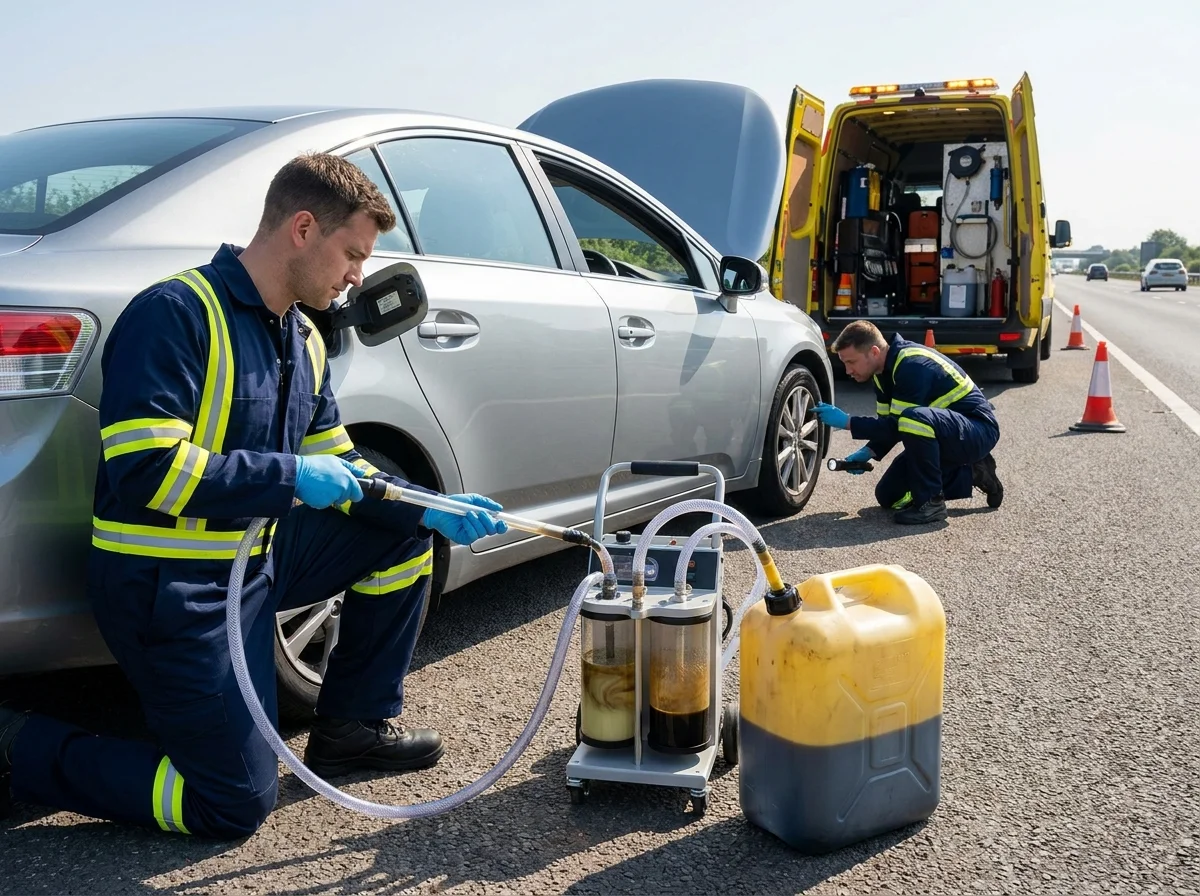
(For Illustrative Purposes Only)
Preparation and Safety Measures
Before starting any fuel drain, our technician will assess your vehicle and confirm the contamination type. This involves checking what fuel was added and how much remains in the tank.
Safety equipment is positioned around your vehicle. All technicians hold SPA Misfuel Passports, the only recognised qualification in the fuel-drain industry. This ensures they follow proper safety protocols.
The work area is secured whether you’re in fuel drain Glasgow, fuel drain Edinburgh, fuel drain Aberdeen, or anywhere across Central Scotland’s recovery zones.
Our mobile fuel drain Scotland service brings all necessary equipment to your location, including UN-approved extraction tools and ATEX-certified pumps that meet strict safety standards.
Selecting the Draining Method
The primary method used is professional syphon fuel extraction. Our technician inserts UN-approved equipment through the filler neck, bypassing any anti-syphon device your vehicle may have fitted.
Modern vehicles often include anti-siphon measures to prevent fuel theft. Professional equipment can navigate these systems without causing damage. The extraction hose reaches deep into the tank to remove all contaminated fuel.
For some vehicle models, particularly those with complex anti-syphon device systems, alternative access points may be used.
This might involve accessing fuel lines directly, though filler neck extraction works for most situations.
Draining Process Duration Comparison
Step 1 – Tank Drain: Contaminated fuel is fully removed from the tank using UN-approved extraction equipment. This takes approximately 10 to 15 minutes, depending on tank size and fuel level.
Step 2 – Fuel System Flush: Clean, fresh fuel is flushed through the fuel lines and injectors to eliminate any residual contamination. The fuel system flush takes approximately 8 to 10 minutes and ensures all traces of wrong fuel are removed.
Step 3 – Prime and Bleed: The fuel system is re-pressurised and bled to restore correct fuel pressure to the injectors. This fuel pump prime process takes approximately 5 to 8 minutes.
Step 4 – Diagnostic Check: If the engine was started or the vehicle was driven, an OBD scan checks for fault codes. This takes approximately 5 minutes.
Step 5 – Restart: The engine started on clean fuel, confirming the job is complete. This final verification takes approximately 2 to 5 minutes.
The total contaminated fuel removal process ranges from 30 to 45 minutes for most vehicles. This timeline applies whether you need wrong fuel recovery in Glasgow, wrong fuel Edinburgh, or wrong fuel Aberdeen services.
Post-Drain Tasks and Timeframes
After the fuel drain process completes, our technician performs final checks. The fuel cap is secured, and all equipment is removed from your vehicle. Any spilt fuel is cleaned from exterior surfaces.
You receive documentation of the service performed. This includes details of fuel removed, fresh fuel added, and any diagnostic codes found. The paperwork takes approximately 3 to 5 minutes to complete.
Our technician explains what happened and guides you to drive away safely. You can typically drive immediately after service completion. Learn more about our services covering all of Scotland.
The entire appointment from arrival to departure usually takes 45 to 60 minutes. This includes the fuel drain process itself, plus preparation and completion tasks.
Total Fuel Drain Time: Standard vs Complex Scenarios
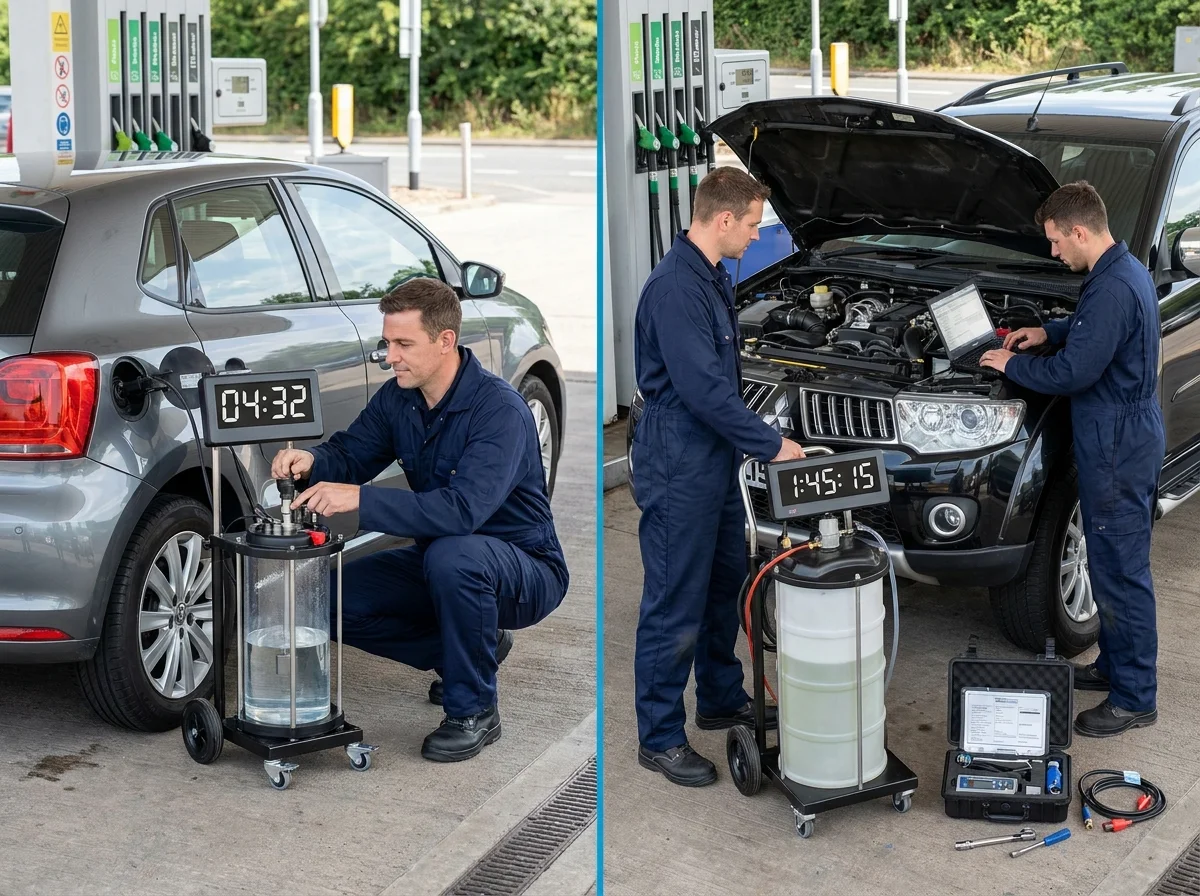
(For Illustrative Purposes Only)
The time a fuel drain takes depends on what happened after you put the wrong type of fuel in your tank. A standard fuel drain takes 35-40 minutes when you catch the mistake right away and don’t start the engine. The technician removes the contaminated fuel from your tank and adds fresh fuel so you can continue your journey.
Complex scenarios take longer because the wrong fuel has moved into the fuel lines. If you started the engine or drove even a short distance, the drain requires a more thorough flush. This takes 60-75 minutes on-site. AdBlue contamination is the most complex situation. When AdBlue gets into a diesel or petrol tank, the fuel tank drain procedure takes 75-90 minutes because it needs special treatment.
| Scenario | On-Site Time |
| Standard drain (engine not started) | 35-40 minutes |
| Engine started / short drive | 60-75 minutes |
| AdBlue contamination | 75-90 minutes |
All these jobs happen at the roadside. You won’t need a recovery truck. Simple Fuel Solutions aims to fix your vehicle within the hour when possible, getting you back on the road quickly.
What to Do While You Wait for Our Technician

(For Illustrative Purposes Only)
After you’ve realised you’ve put the wrong fuel in your car, taking the right steps while waiting for help can prevent serious engine damage. Here’s exactly what you should do:
Important steps after misfuelling:
- Do NOT start the engine – this is the most important thing to remember
- Remove the key from the ignition immediately
- If it’s safe to do so, push your vehicle away from the forecourt pump to a safe parking spot
- Inform the petrol station staff that you’ve misfuelled
- Call Simple Fuel Solutions on 0800 246 5297 (free, 24/7 service)
- Do NOT try to drain or siphon the fuel yourself – this is dangerous and can cause more harm
These actions apply whether you need a fuel drain in Glasgow, Edinburgh, Aberdeen, or anywhere across the Highlands and rural Scotland.
Our mobile fuel drain service covers all of Central Scotland.
Once you’ve called for a wrong fuel recovery service, simply stay with your vehicle and wait. From this point forward, our qualified technician will handle the contaminated fuel removal process and get you back on the road safely.
Essential Aftercare: Engine Restart and System Checks
Fuel System Bleed and Prime Timing
Air enters your fuel system during the drain process. This air must be removed before your engine can start properly.
The bleeding process takes 10 to 20 minutes for most vehicles. Your technician will use a manual pump or the vehicle’s own fuel pump to push fresh fuel through the lines. Diesel vehicles require more thorough bleeding because their fuel systems operate at higher pressures than petrol engines.
The bleed sequence typically includes the following:
- Fuel filter bleed to remove trapped air pockets
- Fuel line pressurisation with clean fuel
- Injector rail purging to clear air from the high-pressure system
Some modern vehicles have automatic bleeding systems that speed up this process. Older models may need manual bleeding at multiple points along the fuel line.
Fuel Injector and Fuel System Flush
A basic drain removes fuel from your tank, but contaminated fuel may still coat your fuel lines and injectors. A fuel system flush pushes clean fuel through every component to remove residue.
The flush takes 15 to 30 minutes, depending on how much wrong fuel is entered into your system.
If you started the engine before realising the mistake, your technician will recommend a more thorough fuel injector flush.
This removes deposits that form when petrol passes through diesel injectors or diesel clogs petrol spark plugs.
Engine Restart Considerations
Your technician will perform checks before restarting your engine. They’ll verify the fuel system is properly sealed and all components are reconnected.
The first start attempt may take longer than usual. Your engine needs to pull fresh fuel from the tank through the entire system. Don’t panic if it cranks for 5 to 10 seconds before firing.
After the engine starts, the technician will let it idle for several minutes while monitoring for unusual sounds or performance issues. They’ll check for fuel leaks around connections and filters.
A diagnostic check may be performed on newer vehicles to ensure no error codes appear.
Frequently Asked Questions
What factors affect the time it takes to drain a fuel tank safely?
The size of your fuel tank is the biggest factor. A small car with a 40-litre tank drains much faster than a commercial van with a 90-litre capacity.
Your drainage method also matters significantly. Professional technicians use high-powered pumps that extract fuel in 15 to 30 minutes. Manual syphoning with a hand pump can take 45 minutes to 2 hours for the same amount of fuel.
The type of contamination changes the timeline, too. If you’ve only added a few litres of wrong fuel, the process is quicker. A completely contaminated tank requires full drainage and flushing of the fuel lines, which adds 15 to 30 minutes to the job.
How can you drain a fuel tank without using a pump?
You can remove the fuel tank drain plug if your vehicle has one fitted. This method lets gravity do the work, but it’s slower than using a pump.
Position a clean container underneath the drain plug location. Unscrew the plug carefully and let the fuel flow out naturally. A typical passenger car tank might take 30 to 60 minutes to empty through the drain plug.
This approach requires mechanical knowledge. If you’re not comfortable working with fuel systems, the risk of spills or damage increases significantly.
You should call Simple Fuel doctors immediately rather than doing it yourself.
What is the safest way to syphon fuel with a hose, and how long should it take?
Use a proper syphon pump with a clear hose rather than trying to create suction with your mouth. Manual syphon pumps cost £10 to £30 and prevent you from ingesting fuel vapours.
Insert the hose into your fuel tank through the filler neck. Push it down until it reaches the bottom of the tank, where the fuel sits. Connect the pump according to the manufacturer’s instructions.
Start pumping to create flow. Once fuel begins moving through the hose, gravity helps maintain the syphon effect. You’ll need to pump periodically to keep the flow going.
A 50-litre tank typically takes 45 minutes to 90 minutes to syphon with a manual pump. Electric syphon pumps cut this time to 20 to 40 minutes. Work in a well-ventilated area and keep containers away from ignition sources.
Where is the fuel tank drain plug typically located, and how do you access it?
Most fuel tank drain plugs sit at the lowest point of the tank underneath your vehicle. You’ll need to get under the car to locate it, either using a jack and axle stands or driving onto ramps.
Look for a bolt or plug on the bottom of the fuel tank. Not all vehicles have drain plugs fitted. Many modern cars omit them entirely, which means you’ll need to use alternative drainage methods.
If your vehicle does have a drain plug, you’ll need the correct size spanner or socket. The plug size varies by manufacturer, but common sizes are 10mm to 19mm.
