
AdBlue® in Diesel Car
We are AdBlue® contamination specialists, removing urea solution from diesel fuel systems across all vehicle types in Scotland.
All of our technicians are fully qualified and fully insured, with hundreds of five-star reviews.
24/7 emergency callouts across Scotland, with prices starting from £275.

AdBlue® in Diesel Tank
Diesel in AdBlue® Tank
AdBlue® in the diesel fuel tank is a more technically specific problem than a standard fuel misfuel, and it’s one where the right response in the first few minutes makes a measurable difference to the outcome.
AdBlue® is a 32.5% urea solution, and when it enters the diesel fuel system, the urea begins to crystallise as the mixture heats or as the water content evaporates. Those crystals are solid and abrasive. They accumulate in the fuel filter mesh, fuel lines and at the precision nozzle apertures of diesel injectors. AdBlue® also has a mild corrosive effect on metals and polymers in the fuel system that were specified for diesel chemistry, not urea.
Standard fuel drain equipment removes liquid. It doesn’t treat crystal deposits. That’s why AdBlue® contamination requires specialist decontamination solutions, which we carry on every AdBlue® callout. Recovery starts from £275.
Check out our recent
Customer reviews
1. DON’T START ENGINE
2. CALL OUR TEAM NOW:
0800 246 5297
3. AWAIT TECHNICIAN
GET HELP NOW!
Call Free on 0800 246 5297
Our aim is 100% satisfaction at a fair competitive price!

AdBlue® Contamination Recovery
AdBlue® in Diesel Insurance
AdBlue® in diesel doesn’t sit neatly within most insurance policy definitions of misfuelling, and it’s worth checking your specific cover rather than assuming.
Some policies treat it as an accidental wrong fluid event and cover it accordingly. Others don’t classify it as a misfuel because AdBlue® is technically a fluid used in the exhaust aftertreatment system rather than a fuel. Check your policy for language around wrong fluid contamination specifically, not just misfuelling.
Simple Fuel Solutions issues a full written job report with every AdBlue® recovery, documenting the contamination type, the specialist treatment applied and the operational sign-off. That’s the document your insurer will need if you’re making a claim.
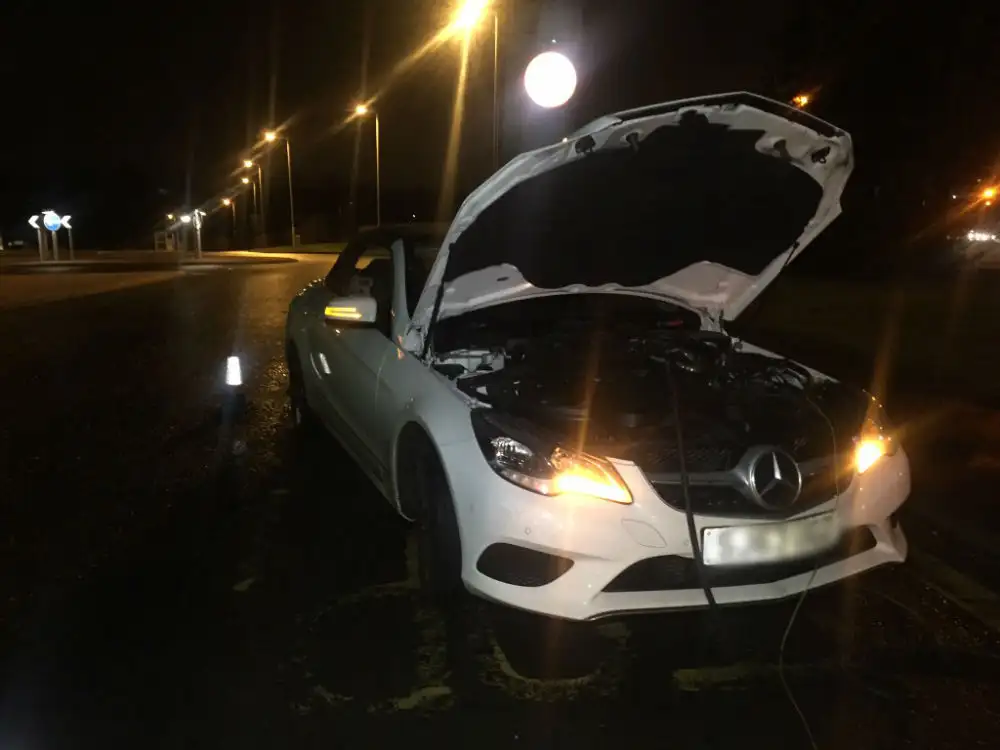
Diesel in AdBlue® Tank
AdBlue® in Fuel Tank
Diesel in the AdBlue® reservoir is the reverse of the more common scenario, and it’s a different recovery with different components at risk.
- The AdBlue® dosing system is built entirely for urea solution: its pump, supply lines and SCR injector nozzle are not designed for diesel contact, and diesel in the reservoir can block the dosing pump strainer and leave residue throughout
- The vehicle will typically show warning lights and may enter a reduced performance or limp mode: Euro 6 diesels are programmed to restrict operation when the SCR system detects a fault
- We drain the AdBlue® reservoir, flush the dosing system and assess the pump and nozzle condition before refilling with correct ISO-grade AdBlue®
If you’re not sure which way round the contamination went, call us and describe what happened.
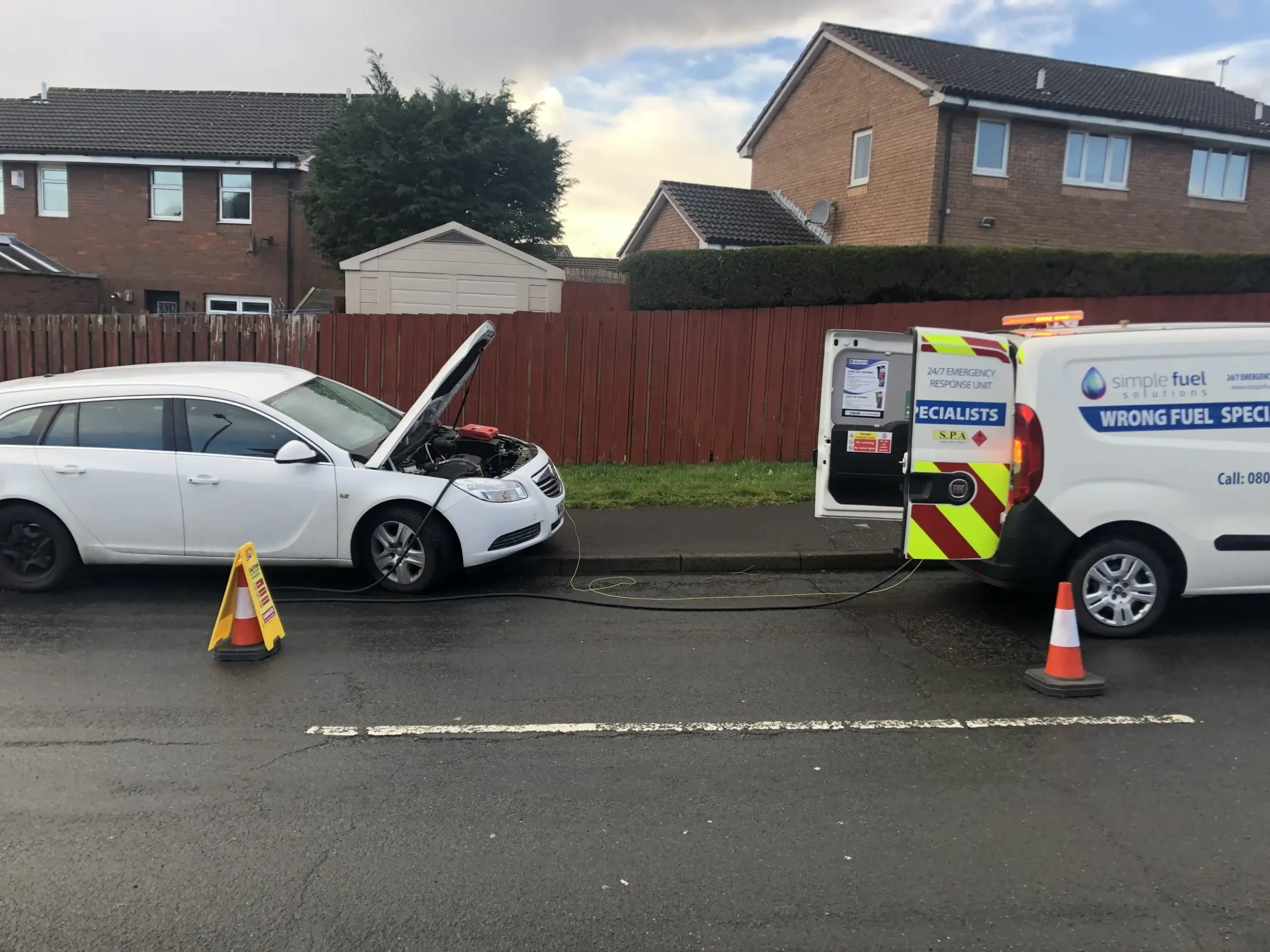
AdBlue® into Diesel Tank
Contaminated AdBlue®
On most modern diesel cars, the diesel filler and the AdBlue® filler are both under the same fuel flap. They’re labelled and colour-coded differently, but their proximity is what creates the risk.
- Fleet drivers topping up AdBlue® manually, hire car drivers encountering an unfamiliar dashboard layout, and anyone using a portable AdBlue® container in a new vehicle for the first time are all in higher-risk situations
- The labelling is there, and it’s clear in ideal conditions, but when you’re in a hurry or not paying close attention, proximity does the rest
- The correct response in every case is the same: engine off, don’t add anything else to the tank, call us
We come with specialist equipment, not a standard drain kit.
AdBlue® Crystallisation
Contaminated AdBlue®
Crystallisation is what makes AdBlue® contamination more involved than a standard fuel misfuel, and it’s the reason the engine-off instruction matters even more in this situation.
When AdBlue® mixes with diesel and the system heats up, the water in the AdBlue® evaporates and solid urea crystals form on every surface the mixture has contacted: tank walls, filter mesh, fuel line interiors and injector nozzle apertures. In a cold, unstarted vehicle, the process is relatively slow. Once the engine runs and the fuel system warms up, crystallisation accelerates significantly.
We use specialist AdBlue® decontamination treatment that dissolves early-stage crystal deposits as part of the flush. Standard fuel drain products aren’t formulated for this. Using the right treatment is the difference between a properly resolved job and one that leaves deposits to cause ongoing problems.

AdBlue® in Diesel Cars
AdBlue® Mixed with Diesel
AdBlue® systems became standard on diesel vehicles built to Euro 5 and Euro 6 emissions specifications; if your diesel was registered after around 2015, it will almost certainly have one.
- The AdBlue® reservoir and the diesel fuel tank are separate systems that should never make contact: the dosing system, injectors and SCR catalyst in the exhaust are calibrated for urea solution, while the diesel fuel system is built entirely for diesel chemistry
- When AdBlue® enters the diesel tank, the urea doesn’t dissolve into the diesel: it separates, begins to crystallise as heat is applied and introduces a corrosive element to components specified for diesel
- This is why a specialist recovery, with the right decontamination treatment, is what’s needed rather than a standard drain
Call us; the right treatment makes a real difference to the outcome.

AdBlue® in Diesel Cost
AdBlue® in Diesel: What to Do
AdBlue® in diesel recovery starts from £275, reflecting the specialist treatment involved. The cost is confirmed on arrival before any work begins.
- The main variables are how much AdBlue® went in, whether the engine was started and the extent of any crystallisation: all of these are assessed on arrival before the technician confirms the full cost
- Keep the engine off while you wait: if you can move somewhere cooler without starting the engine, that slows crystallisation, and don’t add diesel to try to dilute the AdBlue®; it doesn’t prevent crystal formation
- If the fuel filter shows significant crystal restriction and needs replacing, this is discussed and agreed upon before any additional work proceeds
Call us for an honest indication over the phone.
AdBlue® in Diesel Near You
AdBlue® Drain Specialist
If you’re looking for AdBlue® in diesel recovery near you in Scotland, we attend with specialist decontamination equipment on every unit.
Not all fuel drain operators carry the right kit for this. A standard drain removes liquid from the tank. It doesn’t address the urea crystal deposits that form in the filter, lines and injectors as the contamination heats. We carry specialist treatment solutions formulated specifically for AdBlue® diesel contamination, not repurposed from a standard drain kit.
Vehicle in a safe, off-road location before we attend. Call us, tell us what happened, and we’ll get someone heading your way.

AdBlue® in Diesel Symptoms
AdBlue® in Diesel Recovery
Our recovery process for AdBlue® in diesel is built specifically for this contamination type.
- We arrive with specialist AdBlue® decontamination solutions, drain the contaminated fuel from the tank and apply treatment to the tank interior and fuel lines to address urea residue and early-stage crystal deposits before the flush
- The fuel filter is assessed on every AdBlue® job: if crystal restriction means it needs replacing, we go through that with you and agree the cost before proceeding
- We refill with clean diesel, run the engine to verify normal operation and issue a full written job report before leaving, covering the contamination, the treatment applied and the sign-off
Call us, and we’ll get the right equipment to you.
AdBlue® Crystallisation Treatment
AdBlue® Crystallisation Symptoms
The symptoms of AdBlue® in a diesel tank vary considerably depending on whether the engine was started and how far crystallisation has progressed.
Where the engine hasn’t been started, there are often no symptoms at all. The contamination is in the tank as a liquid, and the only indication is reviewing what was actually put in the filler. This is the best stage to catch it; calling us before the engine runs leads to the most straightforward recovery.
Where the engine has been started, symptoms can include fuel pressure warning lights, rough running and power loss as crystal deposits begin restricting the flow through the filter. In more advanced cases, the engine may stall under load and resist restarting. At any stage, the response is the same: engine off, nothing added to the tank, and call us.
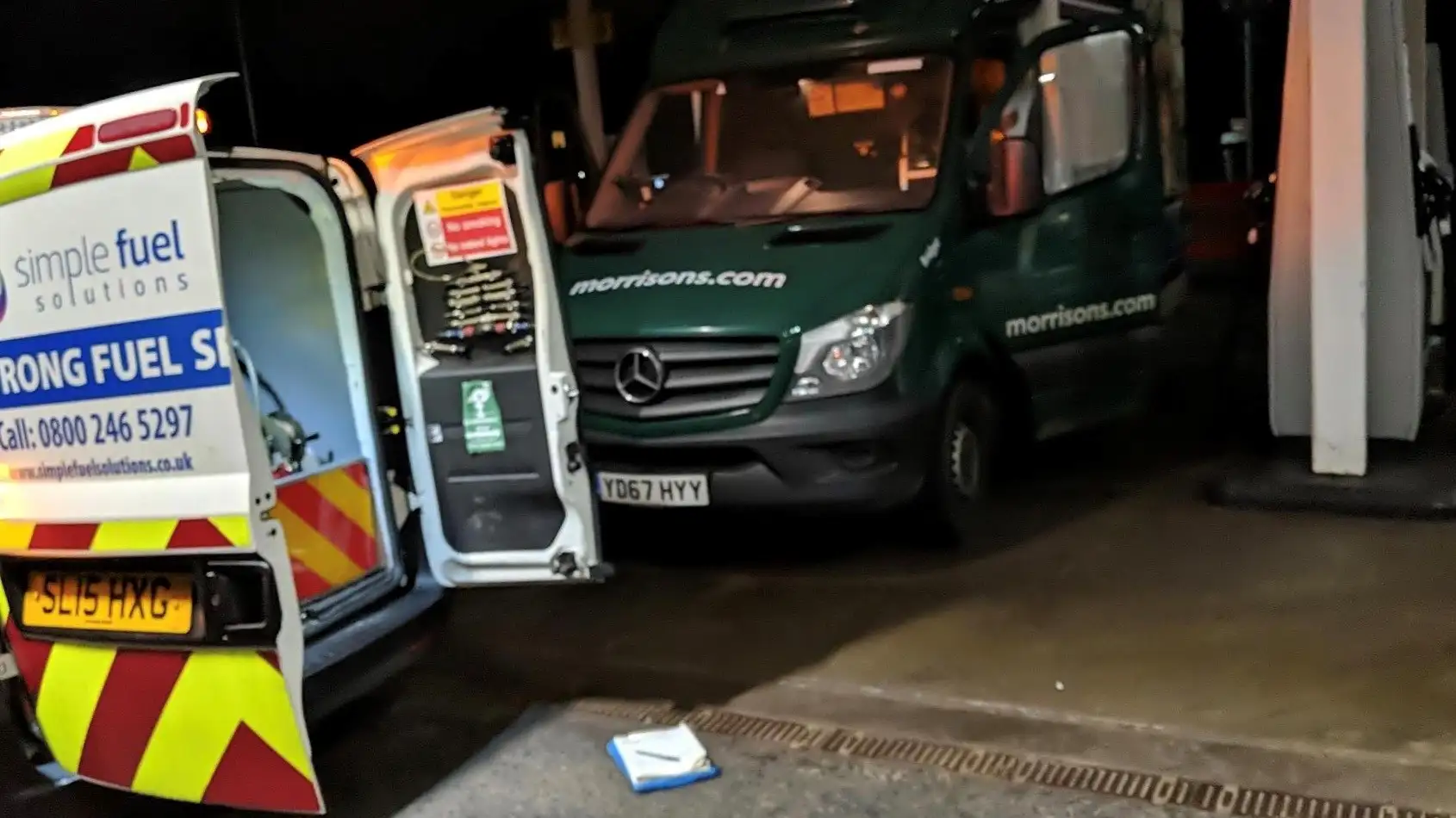
AdBlue® in Diesel Car
AdBlue® in Diesel Recovery
The progression after AdBlue® enters the diesel tank follows a clear pattern determined by heat and time.
- In a cold, unstarted vehicle, the AdBlue® sits as a liquid in the tank and crystallisation is slow: getting us out before the engine runs leads to the most straightforward and cost-effective recovery
- Once engine heat is introduced, the water in the AdBlue® evaporates, and urea crystals form on tank walls, filter mesh and injector surfaces, progressively restricting fuel flow through the system
- In advanced cases, the engine can no longer sustain operation under load and may become difficult to restart due to fuel starvation
The earliest call is always the best outcome. Recovery from £275.
AdBlue® in Diesel Van
AdBlue® Commercial Vehicle Drain
We handle AdBlue® in diesel contamination for vans and light commercial vehicles as well as passenger cars, and fleet and commercial operators are a significant part of our AdBlue® callout work.
Commercial depots where AdBlue® is stored alongside diesel represent a higher-risk environment than a domestic top-up situation. The volume of AdBlue® handled, combined with operational pressure and multiple vehicles, creates more opportunity for the wrong filler to receive the wrong fluid. Commercial vehicle contamination also often involves larger tank volumes, which affects recovery time.
Fleet managers can contact us directly. Full documentation is provided for every commercial recovery, supporting Euro 6 compliance records, fleet maintenance logs and insurance submissions.
AdBlue® in Diesel Faqs
How is AdBlue® contamination different from a standard misfuel?
A standard misfuel puts one fuel type in a tank designed for another. AdBlue® in the diesel tank introduces a urea solution into a fuel system never designed for it. The critical difference is crystallisation: urea forms solid abrasive deposits inside the tank, filter and injectors as it heats, and those deposits require specialist decontamination treatment to address properly. Standard fuel drain products don’t dissolve urea crystals.
How quickly does crystallisation start after AdBlue® enters the diesel tank?
In a cold, unstarted vehicle, the process is relatively slow. Once the fuel system heats up through engine operation, crystallisation accelerates considerably. This is why the engine-off instruction is even more important with AdBlue® than with a standard misfuel; keeping the system cold while we’re on the way significantly limits the damage potential.
Is any amount of AdBlue® in a diesel tank a problem?
Yes. There’s no threshold below which AdBlue® contamination is safe to ignore. Any urea in the diesel fuel system introduces chemistry the system wasn’t designed for and carries crystallisation risk regardless of volume. Call us regardless of how much went in; if the engine hasn’t started, it’s nearly always a more straightforward job than it sounds.
Can I add diesel to dilute the AdBlue®?
No. Adding diesel doesn’t prevent crystallisation. It increases the contamination volume we need to extract and makes the job larger. Leave the tank exactly as it is, keep the engine off and call us.
Do you carry specialist AdBlue® decontamination equipment?
Yes, on every unit we send out. Standard drain equipment removes liquid; it doesn’t address urea crystal deposits. We carry specialist AdBlue® treatment solutions formulated for this contamination type. That’s what makes the difference between a complete recovery and one that leaves residue to cause ongoing problems.
What if diesel has gone into the AdBlue® tank rather than the other way round?
That’s a different recovery involving the AdBlue® dosing system rather than the diesel fuel system, and we handle it. Call us and describe what happened, which filler you used, what you added and roughly how much. We’ll advise on what the job involves before coming out.
Will the fuel filter need replacing?
Sometimes. If crystal deposits have significantly blocked the filter mesh, replacement is the right call rather than trying to flush through a restricted filter. We assess the filter on arrival and go through the options with you before recommending anything. Nothing additional happens without your agreement.
Can you recover a van or commercial vehicle with AdBlue® in the diesel tank?
Yes. We cover vans and light commercial vehicles as well as passenger cars. Fleet managers can contact us directly. We provide full written documentation with every commercial recovery, suitable for Euro 6 compliance records, fleet records and insurance submissions.
How do I prevent AdBlue® going into the diesel tank in future?
Check the filler cap label before inserting any nozzle every time, even on familiar vehicles. On cars where both fillers sit under the same fuel flap, identify both caps before opening either one. If you top up from a portable container, store it separately from fuel containers and read the label before every top-up.
Does Simple Fuel Solutions handle other AdBlue®-related contamination as well?
Yes. We deal with diesel in the AdBlue® reservoir, out-of-date or degraded AdBlue®, and AdBlue® contaminated by water or other substances introduced from an external source. These are distinct scenarios from AdBlue® in the diesel tank, but all situations we can advise on all situations and attend to all situations across Scotland.