

(For Illustrative Purposes Only)
After realising you have put the wrong fuel in your car, the warranty question is usually the first worry that surfaces, often before you have even called for help. That reaction makes sense given what a warranty repair could cost if something goes wrong later. Wrong fuel does not automatically void your warranty in most cases, but the outcome depends on the manufacturer, the dealer, the warranty terms, and how the contamination was handled. This guide explains what manufacturers generally require, why certified documentation matters, and how you can protect your position after a misfuel. Acting quickly with proper wrong fuel recovery gives you the strongest starting point. Call 0800 246 5297 for help now.
Does wrong fuel automatically void your car warranty? (The real answer)

(For Illustrative Purposes Only)
Wrong fuel does not automatically void your entire car warranty. A manufacturer warranty usually covers many separate systems, including the engine, transmission, electrics and bodywork, and misfuelling may only affect the fuel-system element rather than the whole agreement.
The key distinction is between the contamination event itself and any damage that follows. If contaminated fuel is addressed promptly and professionally before it causes harm, your warranty position stays stronger. If the engine runs on the wrong fuel and components are damaged, the manufacturer may treat that specific damage as user error and decline the claim.
Every manufacturer, dealer and warranty agreement is different, so no guide or recovery provider can guarantee a warranty outcome. What you can control is your response: stop the car immediately, do not start the engine, and use a certified recovery provider.
A written job report from a PAS43 certified provider gives you the strongest evidence if a warranty question comes up later. It shows the contamination was identified and dealt with to a nationally recognised standard.
What manufacturers generally look for in a warranty claim

(For Illustrative Purposes Only)
Most manufacturer warranties require you to maintain and use your vehicle according to the manufacturer’s instructions, and putting in the wrong fuel falls outside that requirement. This is exactly why the warranty question arises after a misfuel.
When a fuel-system warranty claim follows a misfuel, manufacturers generally look at a few practical points:
- Was the contamination dealt with quickly?
- Did you use a professional, certified provider?
- Is there documentation showing what happened and what was done?
- Did the engine run on the contaminated fuel, and if so, for how long?
A pattern holds across the industry. A prompt drain by a certified provider, documented in a written report before the engine has run or immediately after it was stopped, gives you the strongest warranty position. A delay, an amateur drain, or missing paperwork weakens that position considerably.
Manufacturers such as VW Group, BMW, Toyota and Ford are useful examples of brands whose warranty terms vary from one model and agreement to the next. Their exact policies on misfuelling should always be checked directly with your dealer, since terms differ between warranty types and can change over time.
Why a PAS43-certified drain supports your warranty position
(For Illustrative Purposes Only)
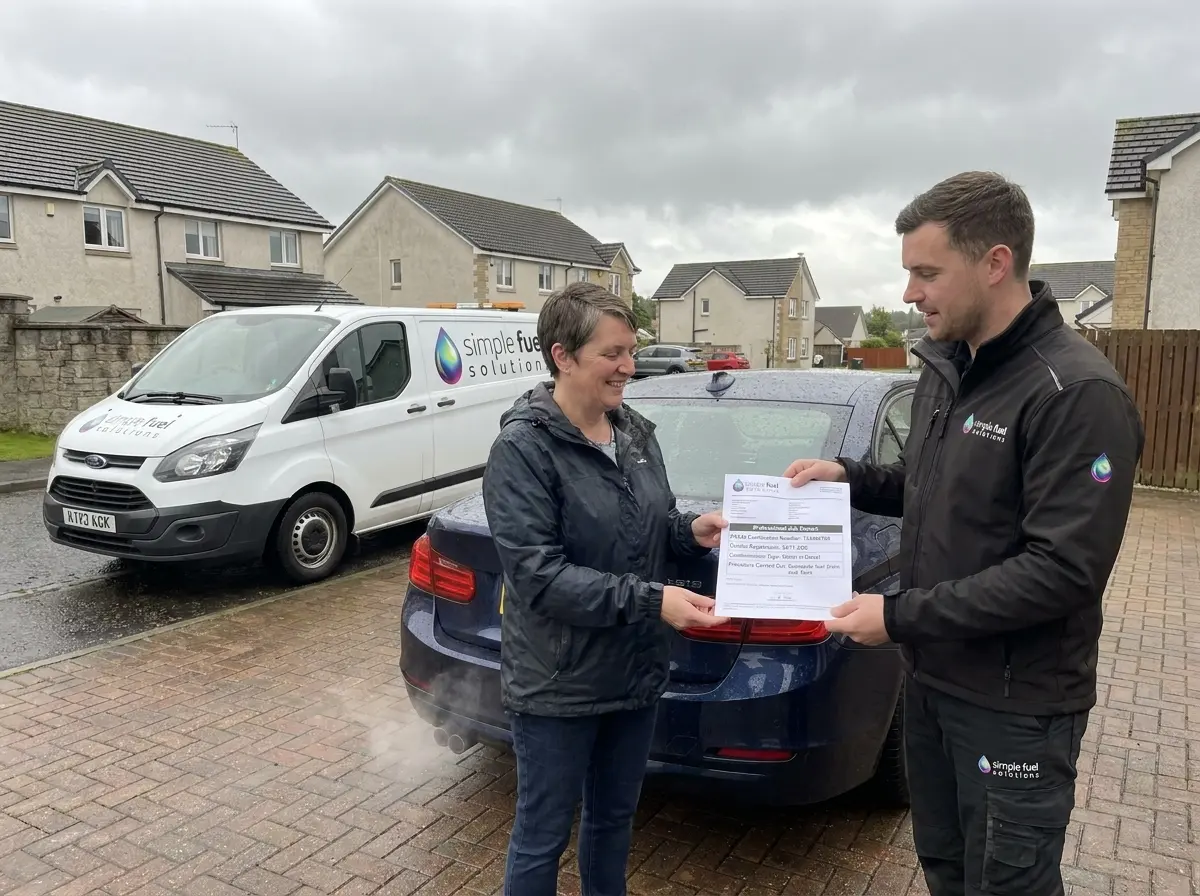
A PAS43-certified drain supports your warranty position by giving the dealer clear evidence that the contamination was handled to a recognised standard. PAS43 is the British Standard for vehicle recovery, independently assessed by BSI, and a provider holding it has been audited on technician training, equipment, procedures and documentation.
This distinction matters when a dealer reviews a misfuel incident. Seeing a drain carried out by a PAS43 certified provider looks very different from seeing no paperwork at all or work done by an uncertified operator with no formal process behind it.
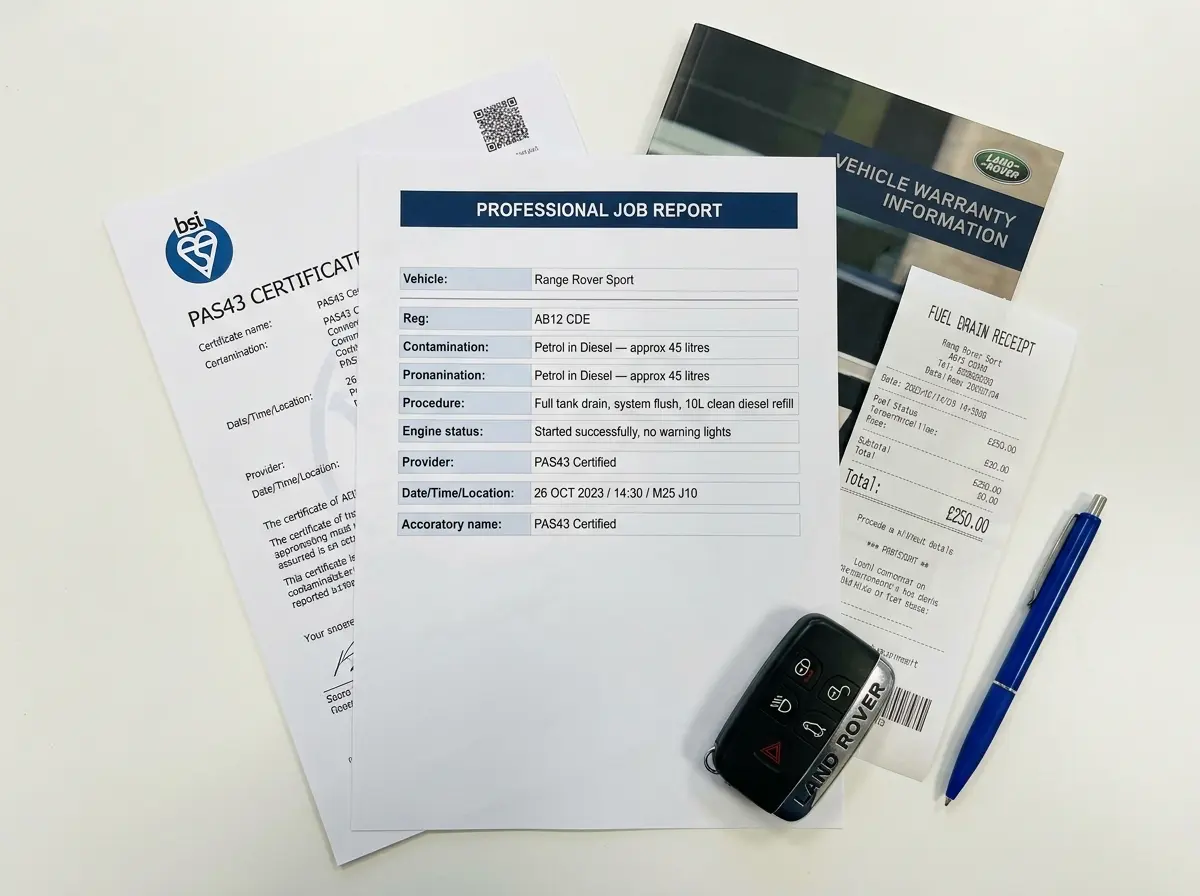
The written job report from a PAS43 certified drain records the vehicle, the contamination, the procedure followed, the flush carried out, and the vehicle’s condition afterwards. This is the document your dealer will actually see if a warranty question comes up.
Simple Fuel Solutions holds PAS43 and ISO 9001 certification and provides this written report with every recovery carried out. Call 0800 246 5297 to arrange a certified drain.
The documentation you need: our compliance certificate explained
(For Illustrative Purposes Only)
The document you need after a misfuel is a written job report, not a generic certificate, and it should cover several specific details about your vehicle and the work carried out.
A proper written job report typically includes:
- Vehicle registration, make, model and fuel type
- Details of the contamination, including what was put in, what the vehicle takes, and the estimated volume
- The procedure followed: what was drained, how the system was flushed, and what clean fuel was added
- The vehicle’s condition after the drain, including whether the engine started successfully, ran normally, and showed no warning lights
- The provider’s PAS43 certification details and the technician’s qualifications
- The date, time and location of the recovery
Several different people may need to see this report. Your dealer or manufacturer may ask for it if a warranty question arises, your insurer may need it to support a claim, a fleet manager may want it for maintenance records, and you may simply want it for your own files.
What if the drain was not carried out by a certified provider?

(For Illustrative Purposes Only)
If your drain was carried out by an uncertified operator with no paperwork, and you later make a fuel-system warranty claim, the dealer has no evidence that the contamination was handled properly. That gap weakens your warranty position, though it does not automatically void the warranty either.
The problem is one of proof rather than an automatic penalty. Without documentation, it becomes harder to show that the contamination was addressed promptly and by someone competent to do the job.
If this has already happened, contact your dealer and explain what took place. Your position is weaker without paperwork, but it is not necessarily lost, and an honest conversation with the dealer is still worthwhile.
For future reference, choosing a certified provider with documented procedures costs the same phone call as choosing an uncertified one, but it gives you materially stronger protection if a warranty or insurance question comes up later.
Conclusion
Misfuelling rarely voids your whole warranty outright, but how you respond in the first few minutes shapes what happens next. Stopping the engine immediately, avoiding a restart, and calling a PAS43 certified provider gives you the strongest position with your dealer, your insurer and your own peace of mind. The written job report that follows becomes your proof that the contamination was handled properly, which is exactly what a manufacturer or dealer will want to see if a claim ever needs discussing.
Frequently Asked Questions
Does a manufacturer warranty cover damage caused by wrong fuel?
It depends on the manufacturer and the specific warranty terms. Most may decline fuel-system claims if damage occurred, but a prompt certified drain before the engine runs gives the strongest position.
Is putting the wrong fuel in a car covered by insurance?
It depends on the policy. Only around 13 percent of comprehensive policies include misfuelling cover as standard, so check your policy schedule for the specific wording.
Can I still claim if I started the engine after misfuelling?
Possibly. Starting the engine weakens your position because contaminated fuel has circulated, but a certified drain with a written report still documents your response. Contact your dealer to discuss the specifics of your case.
Does the written job report help with a finance agreement as well as a warranty?
Yes. The report documents the contamination and the certified response, which supports warranty, insurance and finance condition requirements at the end of the term.
Can wrong fuel cause permanent engine damage?
It can if the engine runs on contaminated fuel for an extended period. A prompt drain before starting, or immediately after, significantly reduces the risk of lasting damage.
Should I contact my dealer before or after the drain?
Either is fine. If time allows, a quick call before the drain lets the dealer note the incident, but if not, the written report from the certified drain covers the documentation needed. Call 0800 246 5297 for help now.
